Black-Tie, Gala and May Ball Makeup: A Face That Lasts Until the Survivors’ Photo
Black-tie and formal makeup, Cambridge edition — how to build a look for a May Ball, a gala dinner or a white-tie evening that holds through nine hours of dancing, fireworks, flash photography and a dawn survivors’ photograph, and still looks like you.
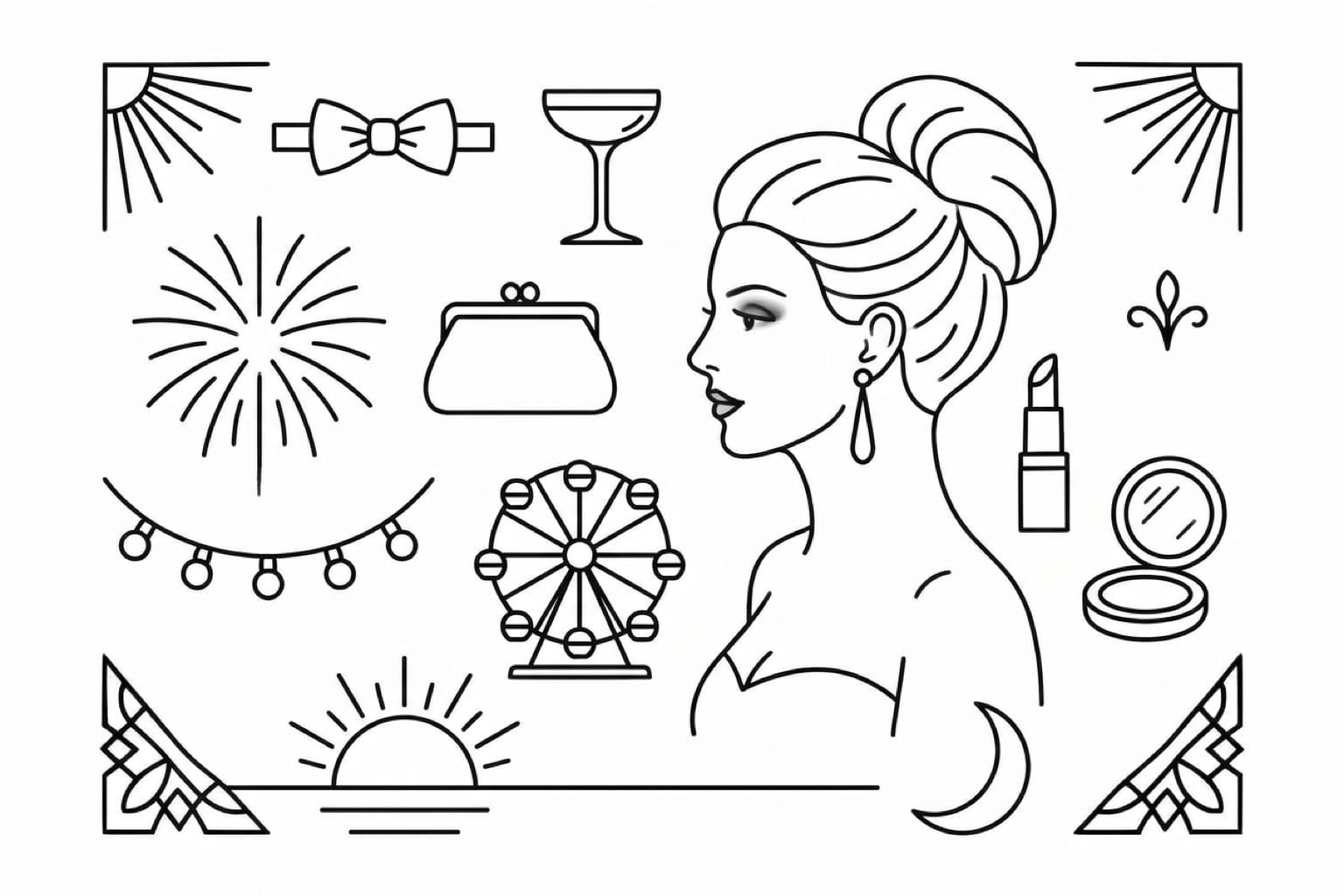
There is no evening in the country quite like a Cambridge May Ball. The gates open at nine, in a college court strung with lights, and for the next nine hours there are bands, fairground rides, fireworks over the river, food at every turn, a dance floor that never empties, and a dress code — black tie almost everywhere, white tie at Magdalene and Peterhouse — that turns a group of exhausted students into something out of a period drama. Then, as the sky lightens over the roofs, everybody still standing is herded onto the lawn for the survivors’ photograph, and it is six in the morning, and your makeup has been on for ten hours.
That photograph is my brief. Formal makeup, whether for a ball, a gala dinner, a black-tie wedding reception, a charity evening or a Christmas party in a college hall, is a different discipline from a daytime face. The light is low and then suddenly white with flash; the room is hot and the courtyard is cold; there is dancing and laughing and, at some point, a plate of something eaten standing up. The face has to hold through all of it and still look like the person who walked in. Here is how I build it, and what I would tell you to do if you are doing it yourself.
Start With The Length Of The Night
The first question I ask about any formal evening is not “what look would you like?” but “what time does it end?”. A gala dinner is four or five hours; a wedding reception might be six; a May Ball is nine or ten, and the survivors’ photo means the end is the part that gets photographed. The answer decides everything about the base, because a face that is meant to last four hours and a face that is meant to last ten are built differently — not more heavily, but more carefully.
The second question is “what will the light be?”. A candlelit dinner in a panelled hall, a marquee lit with festoon bulbs, a dance floor under coloured lights, the flash of a hundred phones, and finally the flat grey of dawn. Formal makeup has to read in the dimmest of those without looking painted in the brightest. This is the tension at the heart of every black-tie face: enough definition to survive low light, enough restraint to survive a flash.
The Base: Thin, Set, And Left Alone
Long-wear formal makeup begins hours before the makeup does — with skin that is hydrated but not slippery. A rich moisturiser an hour before, blotted, is the difference between a base that lasts and one that slides by midnight. Then a primer chosen for your skin rather than for the occasion: a mattifying one only where you actually get shiny, a gripping or hydrating one everywhere else.
The foundation is applied thinly and built where it is needed, never all over in one thick coat. Thin layers move with the face and last; thick ones crack at the smile lines and slide in the heat of a dance floor. A long-wear formula is right for a ball; for a four-hour dinner I would rather use something more luminous and set it well. Concealer goes only where the base has not done the job. Then powder — but only on the centre of the face, where shine happens, and a setting spray to lock the whole thing without the sprayed, flat look that gives cheap setting sprays their reputation. The cheeks stay soft and a little luminous, because a face that is matte everywhere reads as a mask under flash.
One thing I am strict about for any evening with cameras: no sunscreen or powder with a high mineral content on the centre of the face. Those ingredients bounce the flash straight back and leave a pale, ghostly cast in the photographs — the effect people call flashback. The physics of light on skin was, as it happens, worked out in this city, and it applies just as brutally on a dance floor at two in the morning as it did in a Victorian laboratory.
Eyes That Survive Dancing, Heat And Tears
Formal evenings ask more of the eyes than any other occasion. In low light the eye is what reads from across a room, and a softly defined eye that looked perfect at nine can be halfway down the cheek by one if it has not been built to stay.
An eye primer is not optional. It is the single product that decides whether shadow and liner are still where you left them at dawn. Over it, I use long-wear, blendable shadows in a shape that suits your eye (for most people a soft, deepened socket and a lighter lid, brought outwards rather than upwards), and a liner that is set with a matching shadow so it cannot transfer. Mascara is waterproof for a ball, always; fireworks, hilarity, a cold courtyard and the occasional emotional moment at four in the morning all produce tears, and a waterproof formula does not care.
Lashes are a matter of taste. A good set of individual or half-strip lashes, applied properly, lasts a whole night and makes an enormous difference in low light and flash; a full dramatic strip can look wonderful at nine and be sitting slightly askew by three. I would rather build a lash that will still be exactly right in the survivors’ photograph than one that peaks early.
The Lip That Is Still There At Six
If there is one product that fails on a formal evening, it is lipstick. It is eaten off, drunk off, kissed off and danced off, and by midnight most people are lipstick-free and slightly startled to see it.
The answer is layers. A lip liner all over, not just at the edge; a stain or a long-wear liquid colour as the base layer; and the lipstick itself, blotted, on top. When the lipstick wears away, and it will, the stain underneath is still doing its job, and the lip in the photographs at four in the morning is still a lip. For a classic red or a deep berry against black tie, this is the only way I know to keep the colour honest through a whole night. For a softer, nude-pink lip the stakes are lower, but the liner still stops the colour drifting. Whatever the shade, it goes in the clutch bag, because a two-minute top-up before the survivors’ photo is worth more than any product on earth.
The Clutch Bag Kit
Three things, and only three, because a ball is not the place to be carrying a makeup bag. Blotting papers, which take shine off without adding powder; the lipstick, already discussed; and a small pressed powder with a mirror, for the nose and forehead only, at midnight and at dawn. That is enough. If you are the kind of person who worries, add a cotton bud and a tiny tube of concealer for any mascara that has misbehaved — but with a waterproof formula it rarely does.
Black Tie, White Tie And What The Dress Wants
The dress code sets the register. Black tie is formal but expansive — a floor-length gown or a smart cocktail dress, and makeup that can be as classic or as modern as you like, from a soft smoky eye and nude lip to a clean face and a red mouth. White tie, which Magdalene and Peterhouse ask for at their balls, is the most formal dress code there is: long gowns, gloves, jewellery. The makeup that suits it is polished and slightly restrained: a refined eye, a defined but not heavy lip, luminous skin. The drama is in the dress; the face frames it.
Colour is the next decision. The dress that is easiest to dress a face for is black, because everything goes with it and the risk is only paleness — so warmth in the cheek and life in the lip. Jewel colours such as emerald, sapphire and deep red want a face that either matches their intensity or steps right back; a deep red dress with a deep red lip can be magnificent or too much, and which one depends entirely on the person wearing it, which is what a quick trial or a photograph sent in advance settles. Pale and metallic gowns are the most demanding, because they reflect light onto the face and show every unevenness; the base has to be immaculate and the colour kept soft.
The Weather, The Courtyard And The Dawn
A May Ball happens in June, which in Cambridge can mean a warm, still night or a cold, damp one, and usually means both at different times. Courtyards are cold after midnight; marquees and dance floors are hot; the dawn is damp and grey. Makeup that is built for a room will struggle with the courtyard, so the base is set a little more thoroughly than it would be for a dinner, the mascara is waterproof and the lip is layered, as above, and a small blotting-and-powder pause around midnight, when the dance floor is at its hottest, keeps the second half of the night as good as the first.
The survivors’ photograph deserves its own paragraph, because it is the picture that gets kept. It is taken in flat dawn light, which is the most unforgiving light there is — grey, shadowless and honest. What survives it is structure: a brow that is still defined, a lash that is still in place, a lip that is still there, and skin that has been blotted rather than re-powdered into a mask. Everything above is designed for that one frame. If you do nothing else before the photograph, blot, add the lip, and stand where the light is coming from the front rather than from above.
Galas, Dinners And The Shorter Evening
Not every formal evening is a ball. A charity gala, a black-tie dinner in a college hall, a wedding reception with a strict dress code, a company dinner at Christmas — these run four to six hours and are mostly indoors, mostly seated, and lit by candles or chandeliers. The same principles apply with the volume turned down: a luminous rather than long-wear base, a softer eye, a lip that is layered but not armoured. The one thing I would not relax is the flash rule, because gala dinners are photographed constantly — table shots, phone shots, an official photographer working the room — and flashback in a professional gala photograph is a great deal harder to laugh off than in a friend’s phone picture at dawn.
Doing It Yourself, Or Booking It
Everything here can be done at home with the right products and half an hour, and if you would like to learn how, a one-to-one lesson built around your own ball or gala is one of the most useful things I teach: the order of layers, where to set and where not to, how to build a lash that lasts, how to layer a lip. You leave able to do it every time.
If you would rather I did it, that is a special-occasion booking: I come to you, whether that is your college room, your house or your hotel, in the late afternoon or early evening, and you walk into the ball with a face built to last until the photograph on the lawn. For a group getting ready together, which is most of the fun of a May Ball, I book a slot for each of you and bring an assistant if the numbers call for it. Tell me the date and the college, and we will start from the survivors’ photo and work backwards.