Your Bridal Makeup Trial in Cambridge: What to Expect and How to Prepare
What happens at a bridal makeup trial in Cambridge — when to book it, where to have it, what to bring, how the look is built and tested in daylight and flash, and how the trial turns into a calm wedding morning at your college, hotel, country house or barn.
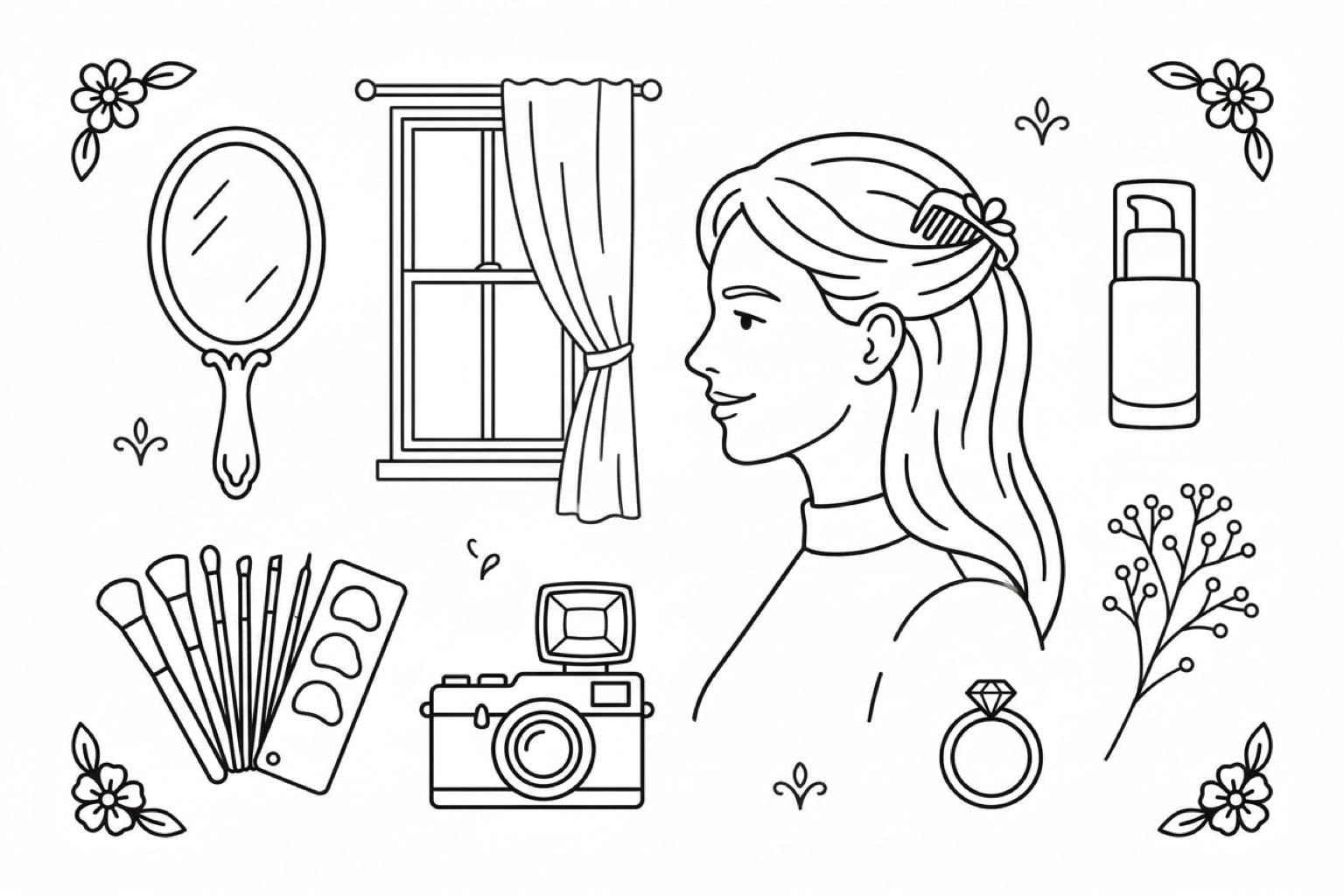
Every wedding I do begins with a trial, and I would not take a bridal booking without one. It is not a rehearsal for the sake of it. It is where the look is actually designed — where we find out what your skin does under a long-wear base, which shape of eye suits the way you smile, whether the lip you have been saving on your phone is really yours, and what all of it looks like in the daylight you will be photographed in and under the flash you will be photographed with. By the time I leave, the wedding morning holds no decisions, only the doing of it.
This is the Cambridge edition of a guide I have written before: what a trial is for, when to have it, where, what to bring, what should happen in the chair, and the handful of things worth asking before I go. If you are marrying in a college chapel, a hotel in town, a country house or a barn out in the fens, the trial is where the venue starts to shape the look.
When To Book It
Four to eight weeks before the wedding is the sweet spot. Close enough that your skin, your hair colour and your tan (or lack of one) are what they will be on the day; far enough that if we want to change something, order a product or arrange a second session, there is time. Trials booked six months out are done on a different face; trials booked the week before leave no room.
If your wedding is in the busy months, May to September in Cambridge, when the colleges, the country houses and the barns are all full, book the trial as soon as the date is confirmed, and I will pencil the wedding in at the same time. A 20% deposit secures the date; the trial itself is usually the first time we meet in person.
Some brides like a second trial. If the first one lands, you will not need it. If we have changed direction (a stronger eye than you expected, a different lip, a decision to add lashes), a shorter second session settles it, and it can double as a lesson in topping up.
Where To Have It
At home, in daylight, by a window. That is the answer for almost everyone, and it is the answer even if you are getting ready somewhere else on the day. Your own home is where you are calmest, where your dress or a photograph of it is to hand, and where the light is honest. I come to you anywhere in Cambridge and across Cambridgeshire, from the city and the villages to Ely, Newmarket, Saffron Walden, Royston, St Neots, Huntingdon and Bury St Edmunds, with the full kit, so there is nothing to organise beyond a chair and a table.
Morning or early afternoon is best, because the light is good and there is time afterwards to live in the makeup. Wear it for the rest of the day. Go out in it. Take photographs in the garden, in the kitchen, in the car, at dinner. The trial is not finished when I leave; it is finished when you have seen the look at nine at night and decided whether it is still you.
If your wedding morning will be in a specific room, such as a suite at the University Arms, a set of rooms in college or the bridal suite at a country house, and you are able to have the trial there, wonderful; we learn the light together. But it is not necessary. I ask about the venue at the trial and plan for it, which is exactly what my guide to Cambridge wedding venues is about.
What To Bring, And How To Prepare Your Skin
Bring photographs. Three or four looks you like, ideally on people whose colouring is somewhere near yours, and, just as usefully, one or two looks you definitely do not want. Bring the dress, or a photograph of it, and the veil or headpiece if there is one; the neckline and the amount of skin on show change the balance of the face. Bring any jewellery you have decided on. If you have a mood board for the flowers and the room, I will happily look at it, because a bride in a white marquee with sage-green flowers is a different picture from a bride in a candlelit panelled hall.
Skin, the honest version. Start any new skincare at least six weeks out, not six days: a vitamin C serum in the morning, a retinoid you tolerate at night, sunscreen every day, and nothing new in the fortnight before the trial. Have facials, waxing, threading or any treatment that reddens the skin at least a week before the trial and at least a week before the wedding, so I see your skin as it will be. Exfoliate gently the night before, moisturise well, and arrive at the trial with clean skin and no makeup — moisturiser is fine; foundation is not, because I need to see what I am working with.
Hair matters too. If your hair will be up on the day, have it up, even roughly, at the trial, so that the face is framed as it will be. If you are booking hair and makeup together, the trial covers both in one sitting.
What Happens In The Chair
The first twenty minutes are talking. The date, the venue, the timings, who else is having makeup, how you wear makeup normally, what you loved and hated about makeup you have had done before. Then I look at your skin in the window light, colour-match the base (warm against cool, yellow against pink, tested on the jaw and checked against the neck and chest), and we settle the direction: skin-first and natural, a soft glamour, or something with more intent.
Then I build the look, slowly, talking through each step so you understand what is being done and why. You are welcome to stop me at any point. A base that is thin, long-wearing and set only where it needs to be. A brow that is groomed, not drawn. An eye shaped for your eye, whether hooded, deep-set or almond, in colours that live with your colouring rather than fight it. Blush placed where a real blush sits. A lip that is lined, stained and layered so it lasts. Lashes, if you want them, in a style we choose together.
Then the tests. We look at it in the window. We look at it in the room’s ordinary light. I take a photograph with a flash, because flash tells the truth about a base and the wrong powder in the wrong place will show up now rather than in your album. I photograph you from the side and from slightly above, which is where a photographer will be. And I ask you to smile properly, laugh, and move — because a face that only works still is no good to a bride.
The Decisions We Make Together
Most of what gets decided at a trial is small and matters enormously. Whether the eye should be softer or stronger than the photograph you brought. Whether the lip you love reads as you or as somebody wearing a lip. Whether to add lashes, and which kind. Whether the base needs to be more luminous for a candlelit college hall or more set for a garden reception in July. Whether your skin needs a specific primer, a particular concealer, a different approach around the nose or the eyes.
One conversation I always have is about the difference between how you look in a mirror and how you will look in the photographs. Makeup for a wedding is a little more than everyday (not much, but a little), because cameras and distance soften everything, and the face that looks perfect in a mirror at arm’s length can look slightly faded across a chapel. At the trial we find the level that reads as you, on a very good day in the photographs and does not feel like a costume in the mirror. Every bride draws that line in a different place, and the trial is where you draw yours.
What To Ask Before I Leave
A few questions worth asking any artist at the end of a trial, and the answers you should expect from me.
What time will you arrive on the day? I work the timing backwards from your leave-time: roughly an hour and a quarter for you, forty-five minutes to an hour for each other face, finished forty-five minutes to an hour before you need to go. I will send you the plan in writing. For a large party I bring an assistant rather than starting at five in the morning.
What will I need on the day? A chair by a window, a table and a socket. If the getting-ready room has no daylight (some of the older college courts, some barn cottages), I bring lighting.
What is in my touch-up kit? Powder, the lip, blotting papers. I leave them with you or with a bridesmaid who can be trusted with them, with two minutes of instruction. For a long country-house day I will say so if I think a mid-afternoon top-up is worth planning.
What if I change my mind? Tell me. Between the trial and the day, if you decide the lip should be softer or the eye stronger, a message is all it takes; I write the look down in detail and adjust it. On the morning itself, small changes are easy and we make them together.
From The Trial To The Morning
By the end of the trial I have a written record of every product and every decision, a set of photographs in daylight and flash, and a plan for the morning that takes your venue into account — the walk through town from a college room, the timetable of a hotel suite, the long afternoon in a country-house garden, the weather at a barn. Nothing is left to decide on the day.
And that is the point. The wedding morning should be one of the calmest parts of a very full day: you in a chair by a window with coffee, the people you love drifting in and out, and someone who has already done this exact face on you once before, doing it again. If you would like that morning, tell me about the day: the date, the venue, and a sense of what you are picturing. We will find a date for the trial.